

Japan Detour
Don't just change trains at Tsuruga
The Hokuriku Shinkansen's 2024 extension forces every Tokyo-Kyoto arch traveler to change trains at Tsuruga. Why you should spend the night: the Port of Humanity museum, Kehi no Matsubara, and the interchange penalty explained.
Nov 20, 2026 · 7 min read
Japan Detour #1. Every day, one place, stay, route, or experience in Japan worth changing a thoughtful traveler's itinerary for.
Don't Just Change Trains at Tsuruga
The Fast Line's Forced Stop
The fastest new railway in western Japan ends in a city you can't place on a map.
For years Japan pushed the Hokuriku Shinkansen west from Kanazawa. When the extension opened on March 16, 2024, the fastest Tokyo to Tsuruga run fell to 3 hours 8 minutes, fifty minutes quicker than before. The celebration was about speed.
The result is that you must get off in Tsuruga.
Tsuruga is a port city in Fukui Prefecture. Until 2024 it was a place the limited expresses passed through on their way to Kanazawa. Now it is where every limited express terminates and every Shinkansen from Tokyo ends. If you travel the great arch route, Tokyo to Kanazawa to Kyoto, Tsuruga is no longer a dot on the line. It is the hinge.
One such detour every day. If this is your kind of travel intelligence:
The Transfer Everyone Promised Wouldn't Hurt
The official story is reassuring, and it is mostly true. Tsuruga Station was rebuilt for the interchange: Shinkansen platforms on the third floor, Thunderbird limited expresses on the first, escalators and transfer gates arranged so the connection takes ten to fifteen minutes. Book both segments at once and a single ticket carries you through the transfer gates.
Don't fear the transfer. It genuinely works.

But "seamless" is the wrong word for what happened, because the transfer isn't the story. The severed through-service is.
What Actually Got Cut
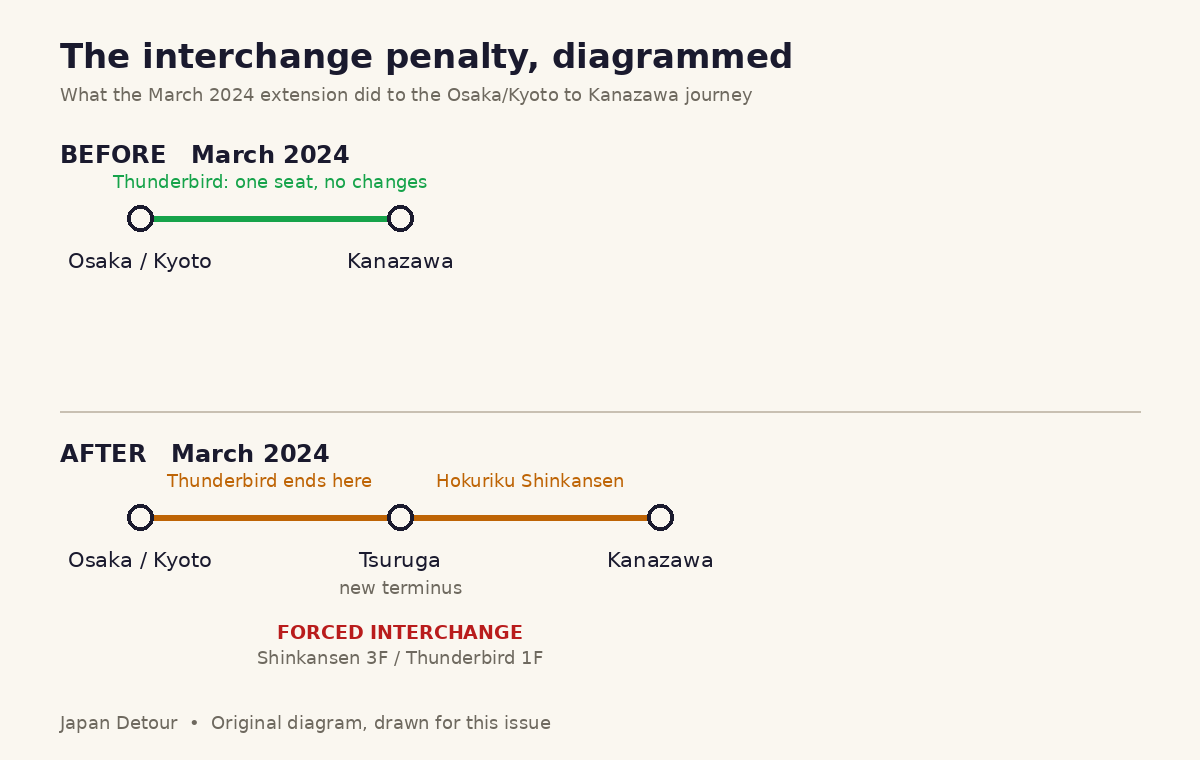
Before March 2024, the Thunderbird ran straight from Osaka and Kyoto to Kanazawa, and the Shirasagi ran from Nagoya to Kanazawa. One seat, no changes. The extension ended both through-services: the Thunderbird now runs Osaka to Tsuruga, the Shirasagi runs Nagoya to Tsuruga, and everyone headed for Fukui, Kanazawa, or Toyama changes to the Shinkansen at Tsuruga.

The line got faster, and the journey got a mandatory interchange.
This is the part the speed announcements skip.
The Interchange Penalty
Call it the interchange penalty. When a fast line terminates somewhere new, the minutes it saves on the fast segment get collected at the interchange, and the trip gets worse for everyone who isn't going to the new terminus.
The penalty falls unevenly, which is what makes it interesting. Tokyo to Fukui or Kanazawa: much better than before, no contest. Osaka or Kyoto to Kanazawa: you traded a direct limited express for a fast train plus a change of trains and floors. Faster on paper, more fragmented in practice. Nagoya to Kanazawa: the same story via the Shirasagi.
And the fastest way from Tokyo to Osaka remains what it always was, the Tokaido Shinkansen direct in about two and a half hours. The arch route via Tsuruga was never about Tokyo to Osaka speed. It is about everything in between.
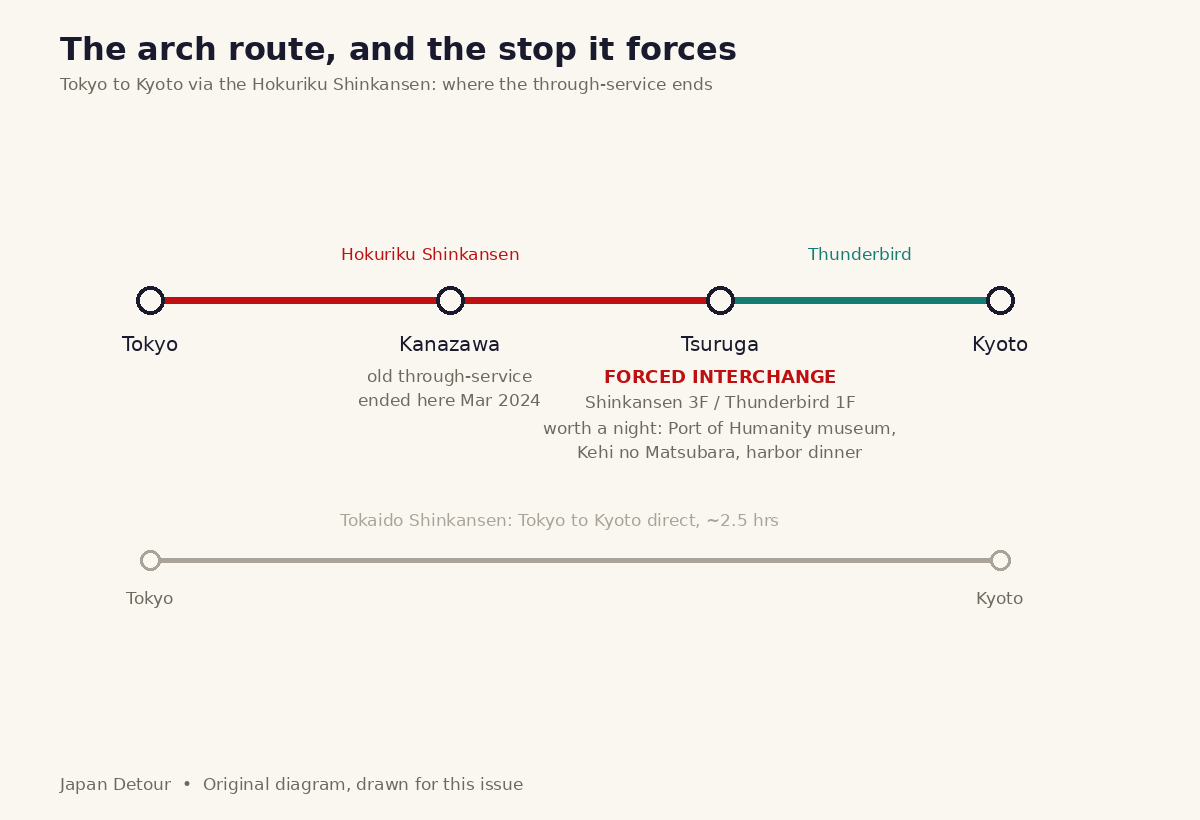
So the real question the extension asks is not whether the transfer is smooth. It is: now that you have to stop at Tsuruga anyway, what will you do with the stop?
A City Built for the Interchange
Here is the thing about Tsuruga: it has always been an interchange. That is its entire history.
From the Meiji era into the early Showa period, Tsuruga was Japan's departure point for the Trans-Siberian Railroad, the port where you boarded for Vladivostok and the long rail journey to Europe. The city prospered as an international port town around the turn of the twentieth century. Its whole economic reason was being the place you changed ships and trains.
Twice, that interchange became the scene of extraordinary history. Between 1920 and 1922, 763 Polish orphans rescued from Siberia landed at Tsuruga and were sheltered there before repatriation. In 1940 and 1941, thousands of Jewish refugees carrying Chiune Sugihara's "visas for life" rode the Trans-Siberian to Vladivostok, crossed the Sea of Japan by ship, and stepped onto Japanese soil for the first time at Tsuruga, where local citizens fed them, gave them baths, and helped them onward.
The Port of Humanity Tsuruga Museum tells both stories. It opened in 2008 and moved into a new building, modeled on the Western-style port buildings of the early 1900s, in November 2020. It sits near the water at Kanegasaki Park, about thirty minutes on foot from the station, or a short bus ride plus a walk.

A transfer city, then a transfer city again. The Shinkansen just made it literal.
What the Guides Miss
English guides cover the Tsuruga transfer as pure logistics: which floor, how many minutes, which ticket. What they miss is that the logistics made Tsuruga the easiest worthwhile stop on the entire arch route.
Consider the traveler's actual day. You are doing the classic Tokyo to Kanazawa to Kyoto arc. The old plan blew through Fukui Prefecture at limited-express speed. The new plan forces a change at Tsuruga mid-afternoon. The museum, the pine grove of Kehi no Matsubara, and seafood by the harbor are all within a short radius of the station.
The interchange penalty, paid once, buys the one thing the arch route always lacked: a reason to stop between Kanazawa and Kyoto that isn't another temple city.
Who Should Do This, and Who Shouldn't
Do this if you are traveling the arch route with more than one night to spend between Tokyo and Kansai. Break at Tsuruga in the afternoon, see the museum, walk the pines, eat by the water, and continue refreshed the next morning. The transfer you resented becomes the most distinctive stop on the trip.
Skip it if you are going Tokyo to Osaka nonstop. Take the Tokaido Shinkansen and don't think about Tsuruga again. Skip it too as a standalone destination from Tokyo: Tsuruga earns its place as a break in a longer journey, not as the journey itself.
If you go
Break the Tokyo-Kanazawa-Kyoto arc at Tsuruga in the afternoon. The transfer is Shinkansen 3rd floor to Thunderbird 1st floor, ten to fifteen minutes, one ticket covers both segments. The Port of Humanity Tsuruga Museum is about thirty minutes on foot from the station or a short bus ride plus a walk; it keeps daytime hours and visitor reports note Wednesday closures, so verify before you build a day around it. Kehi no Matsubara and the harbor are nearby. Tsuruga is a small working port city, not a polished tourist strip.
Come for the history and the harbor.
The extension's engineers solved the transfer. What they couldn't solve is that a terminus is a terminus: someone always has to get off. The mechanism is indifferent, which is exactly why the traveler's move is to stop fighting it.
Don't just change trains at Tsuruga. The fast line built you a stop. Use it.


